Leave Your Message
Buying a Mobile Toilet for an international project involves more than comparing prices and exterior designs. Climate, user volume, transport distance, servicing access, and local operating conditions can change the best choice. A unit that works beside a quiet construction site may fail at a crowded festival. Small details matter, including door clearance, tank capacity, ventilation, handwashing space, and floor stability.
Portable sanitation consultant David Newman offers a practical reminder: “The best unit is the one that is serviced before users notice a problem.” That principle should guide every purchasing decision. Buyers need to examine cleaning schedules, waste-tank access, spare-part availability, odor-control systems, and supplier response times. Ask for service records, not only attractive product photos. Look closely at hinges, locks, non-slip flooring, and lifting points. These parts face repeated use, muddy ground, and rough transport.
This guide presents 10 Mobile Toilet buying tips for global buyers. It considers durability, hygiene, accessibility, logistics, environmental performance, and long-term operating costs. A lower purchase price can become expensive after frequent repairs or difficult servicing. The checklist is helpful, but it is not perfect. Local users may reveal needs that specifications miss. A remote mining camp, a public event, and an emergency shelter require different solutions. Test assumptions with operators and intended users before ordering. Measure the route, confirm the delivery equipment, and calculate realistic daily usage. Good purchasing is rarely dramatic. It is careful, evidence-based, and sometimes slower than expected. That pause can prevent a costly mistake.
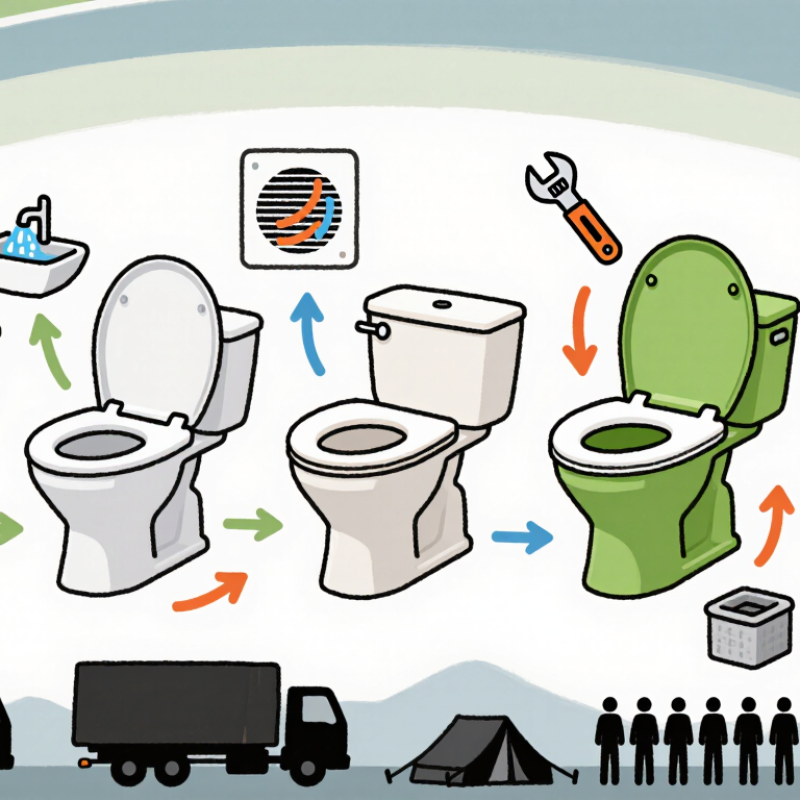
10 Mobile Toilet Buying Tips for Global Buyers
Define Site Needs, User Capacity, and Intended Toilet Type
Buying a mobile toilet starts with the site, not the product brochure. Inspect ground conditions, access roads, drainage options, weather exposure, and service space. A construction site may need compact units near changing work zones. An outdoor event may require wider access, lighting, handwashing, and orderly queues. Do not guess. Measure delivery routes before ordering. Sharp turns, steep slopes, and soft ground can delay placement and raise handling costs.
Estimate capacity from peak use, not the daily average. Count expected users during the busiest 15-minute period, then consider event duration, meal breaks, and alcohol-free family areas. Construction crews may need nearby facilities throughout the shift. Event visitors create sudden demand before performances and during intermissions. A small buffer is sensible, although excessive units can waste budget and service resources. This is where planning often becomes imperfect.
Choose the toilet type according to infrastructure and maintenance access. A flush unit needs dependable water, drainage, and waste connections. A holding-tank unit offers greater flexibility but requires scheduled pumping. Accessible units need level approaches, turning space, support rails, and clear internal room. In hot climates, ventilation and odor control deserve careful attention. In cold regions, freezing protection matters. Confirm local sanitation, accessibility, transport, and waste-handling requirements with qualified authorities before purchase.
| No. | Buying Tip | Key Site or User Data | Recommended Planning Guidance | Specification Check |
|---|---|---|---|---|
| 1 | Estimate peak user capacity | Expected visitors, employees, event duration, and peak arrival periods. | Size the fleet for peak demand rather than average daily attendance. For short events, allow approximately one toilet per 50–75 users, then refine the quantity using local regulations and event conditions. | Confirm the number of units, operating hours, expected queue tolerance, and whether separate facilities are needed for staff or guests. |
| 2 | Define the intended toilet type | Standard use, accessible use, handwashing, showering, changing, or restroom-trailer requirements. | Use standard units for general demand, accessible units for mobility needs, and flushing or trailer systems where a higher-comfort experience is expected. | Check waste technology, flushing method, handwashing provision, mirror, lighting, ventilation, and interior layout. |
| 3 | Plan for accessibility | Users with wheelchairs, walkers, limited balance, or assistance requirements. | Include accessible units with a level entrance, sufficient turning space, support rails, clear transfer space, and a door that can be operated safely. | Verify dimensions against the destination country’s accessibility code; requirements vary by jurisdiction and facility type. |
| 4 | Match the unit to the site surface | Grass, asphalt, concrete, gravel, sand, slopes, soft ground, and ground-level changes. | Choose a stable, level placement area with safe pedestrian access. Soft or sloped ground may require temporary platforms, leveling, or anchoring. | Check base dimensions, total loaded weight, leveling points, anchoring method, ramp compatibility, and delivery access. |
| 5 | Calculate holding-tank and service capacity | Users per day, service interval, water availability, and waste-removal access. | Select tank capacities that support the planned service interval without exceeding safe fill levels. High-use sites require more frequent pumping or additional units. | Request fresh-water and waste-tank capacity, estimated uses per service, fill indicators, drain locations, and pump-truck access requirements. |
| 6 | Consider climate and weather exposure | Temperature range, ultraviolet exposure, rainfall, snow, humidity, wind, and coastal conditions. | Specify insulation or freeze protection for cold climates, ventilation for heat, corrosion-resistant hardware for humid or coastal areas, and secure anchoring for windy sites. | Check operating temperature range, roof drainage, floor grip, UV-resistant materials, wind-restraint provisions, and winterization options. |
| 7 | Review cleaning and hygiene features | Cleaning frequency, available water, sanitation labor, user turnover, and hygiene expectations. | Prioritize non-porous surfaces, smooth corners, easy-access service panels, effective ventilation, handwashing, soap, paper supplies, and touch-free options where practical. | Confirm cleaning access, chemical compatibility, consumable storage, odor-control method, floor drainage, and replacement-part availability. |
| 8 | Check utilities and energy needs | Connection to water, sewer, electricity, drainage, or operation without fixed utilities. | Choose self-contained systems for remote locations. For connected systems, verify utility pressure, drainage route, electrical supply, and local installation rules. | Record voltage and frequency, plug type, power consumption, water inlet size, waste outlet size, battery or solar options, and backup requirements. |
| 9 | Verify transport and installation logistics | Road width, gate clearance, lifting equipment, delivery distance, storage area, and installation time. | Measure the complete delivery route before purchase. Account for unit dimensions, loaded weight, turning radius, lifting points, and temporary storage. | Request packed dimensions, shipping weight, unloading method, forklift or crane requirements, assembly instructions, and site-preparation drawings. |
| 10 | Confirm regulations and total ownership cost | Destination-country standards, permits, waste rules, accessibility obligations, taxes, shipping, service, and spare parts. | Evaluate purchase price together with freight, installation, consumables, pumping, cleaning, repairs, replacement parts, and end-of-life disposal. | Obtain compliance documents, material specifications, warranty terms, user manuals, maintenance schedules, spare-part lists, and after-sales support details. |
Planning note: User-to-unit ratios and accessibility provisions are general planning guidance. Always confirm the final design with the regulations, public-health requirements, and site conditions applicable in the destination country.